When to Take Iron Supplements: Food, Timing & Spacing
Iron absorbs best on an empty stomach, but a lot of people find it upsets their stomach that way, so a small amount of food is a common trade-off. Whichever you choose, keep iron away from calcium-rich foods or supplements taken at the same moment, since the two compete for absorption.
When to take iron supplements: empty stomach vs. with food
The absorption logic for iron is well established: stomach acid helps convert iron into the form your gut absorbs most efficiently, and food — especially dairy and other calcium sources — can blunt that process. That's why "empty stomach" is the textbook answer for maximizing how much of each dose actually gets absorbed.
In practice, iron is also one of the more stomach-unfriendly supplements on an empty stomach, causing nausea or cramping for a meaningful share of people who try it that way. If that's you, taking it with a small amount of food — something light, not a full calcium-heavy breakfast — is a reasonable compromise. You'll absorb somewhat less than you would on a truly empty stomach, but a dose you can actually keep down and keep taking daily beats a theoretically-optimal dose you stop taking after three uncomfortable mornings.
Spacing iron from calcium and other minerals
This is the piece of iron timing advice worth actually remembering: iron and calcium compete for the same absorption pathway, so taking an iron supplement at the exact same moment as a calcium supplement, a big glass of milk, or a calcium-fortified food measurably reduces how much iron gets absorbed. The fix is simple — put some distance between them, generally a couple of hours, rather than taking your iron and your calcium (or your iron and a dairy-heavy breakfast) in the same five minutes.
This isn't a safety issue, it's an efficiency one — you're not doing anything harmful by taking them together occasionally, you're just getting less value out of the iron dose. If iron is the supplement you actually need to land, it's worth building your other supplements and meals around leaving it some space.
What to take iron with instead
Vitamin C is the commonly cited pairing that helps rather than hurts — a glass of orange juice or a vitamin C-containing food alongside iron is associated with better absorption, for people who want to try to improve on an empty-stomach dose without adding discomfort. This is general, widely known nutrition knowledge rather than something specific to any one product, and it doesn't override checking your own label or provider's guidance for your specific supplement and situation.
Morning or night for iron
Morning is the more common default, mainly because it's easier to keep it away from a dinner that might include dairy or a calcium supplement, and because taking a stomach-sensitive supplement earlier in the day gives you more waking hours to deal with any discomfort. Night works fine too if mornings are rushed for you — just keep the same calcium-spacing principle in mind regardless of which end of the day you land on.
Keeping iron timing consistent
Iron is a supplement where the "which meal, how much space from calcium" logistics genuinely matter, which makes it a good candidate for tracking rather than winging it daily:
- Pick a consistent anchor (with or without food, whichever you tolerate) rather than switching day to day.
- Note what to avoid pairing it with so you're not relearning the calcium-spacing rule every morning.
- Log doses if you're taking iron for a specific, time-limited reason, so you can see the actual pattern of what you did rather than guessing in hindsight.
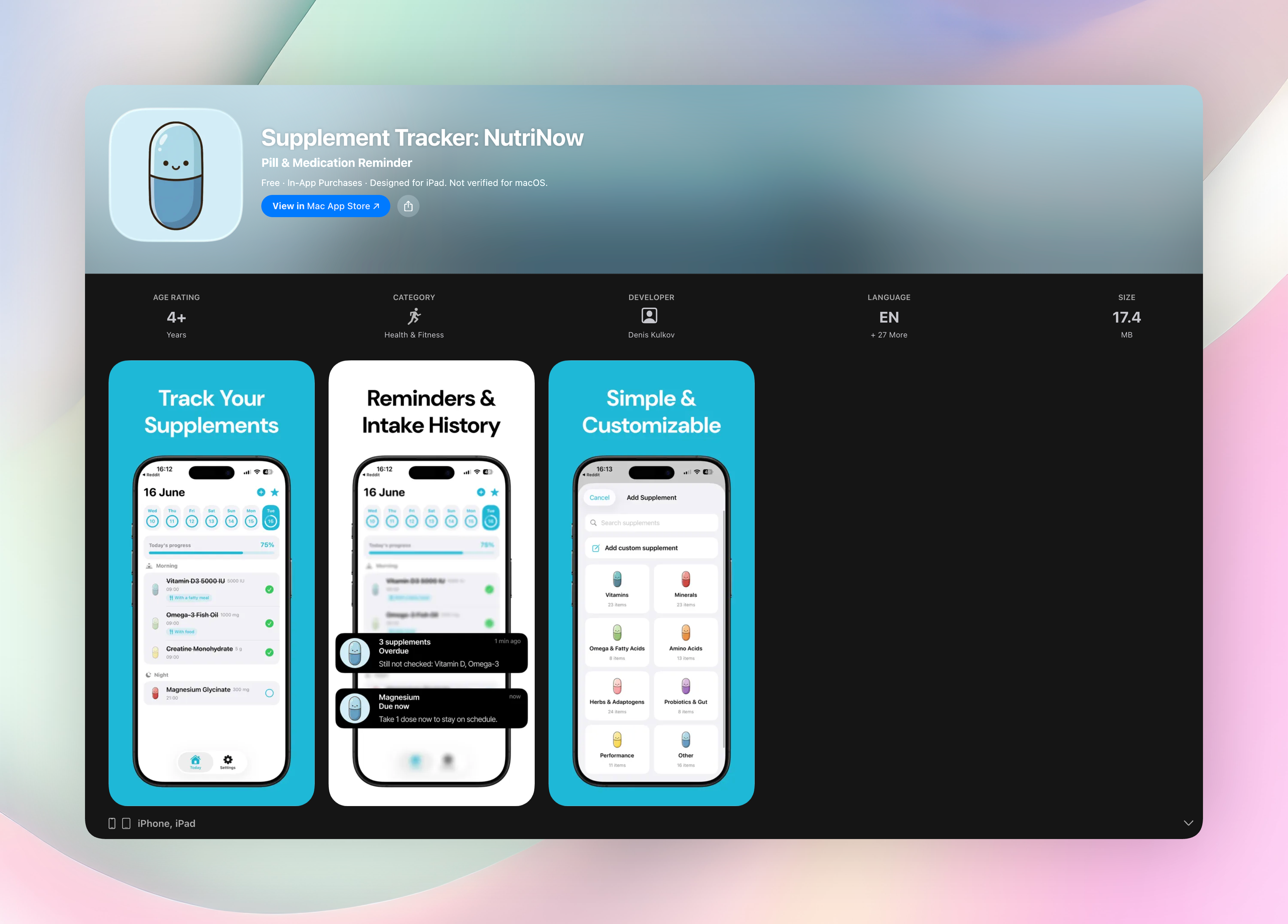
Supplement Tracker is a free app for adding your supplements, logging each dose with one tap, seeing a countdown to your next dose, setting reminders, and keeping a full intake history — no account required — useful for keeping a clear record when timing and spacing actually matter, like they do here.
For the same "consistency over precision" habit-building approach applied more broadly, see when is the best time to take vitamins. And if magnesium or vitamin D are also in your routine, when to take magnesium and when to take vitamin D cover how those fit around meals too.
FAQ
Should iron be taken on an empty stomach?
Absorption is generally better on an empty stomach, but iron is also more likely to cause stomach upset that way. Taking it with a small amount of food is a common compromise if an empty stomach doesn't agree with you.
Can I take iron and calcium at the same time?
It's better to space them apart by a couple of hours if possible. Iron and calcium compete for the same absorption pathway, so taking them together reduces how much iron your body actually absorbs.
Does vitamin C help iron absorption?
Yes, this is well-established general nutrition knowledge — pairing iron with vitamin C, such as a glass of orange juice, is commonly associated with improved absorption. It's a helpful pairing to know about, not a required step.
Is it better to take iron in the morning or at night?
Morning is a common default mainly because it's easier to keep away from a calcium-heavy dinner and gives you more of the day to handle any stomach discomfort. Night works fine too as long as you keep it spaced from calcium sources.
Free Supplement tools
- Vitamin IU to Mcg ConverterConvert a vitamin label quantity between IU and micrograms. Select the exact vitamin form because IU is a measure of biological activity and its mass conversion is not universal.
- Supplement PlannerTurn the supplement choices you have already made into a simple browser-based timetable. The planner organizes entries; it does not recommend doses or check interactions.