
When Is the Best Time to Take Vitamins?
There's no single clock time that works best for everyone. When is the best time to take vitamins comes down to two things: pairing fat-soluble vitamins with a meal that has some fat in it, and picking a slot — morning or night — that you'll actually repeat every day.
When is the best time to take vitamins, really?
Search around long enough and you'll find someone insisting vitamins have to be taken first thing in the morning, and someone else swearing by bedtime. Both are right, and both are wrong, because "best" here isn't really about the clock. For most vitamins and minerals, the body doesn't care whether you swallow the capsule at 7am or 9pm. What it cares about is whether there's food in your stomach at the time (for a handful of nutrients) and whether you do this on a schedule your body — and your memory — can predict.
The exception that actually matters is the fat-soluble group: vitamins A, D, E, and K. These dissolve into dietary fat during digestion, so taking them alongside a meal that has some fat in it (eggs, nut butter, olive oil, dairy, avocado — nothing exotic) measurably helps absorption. Taking them on a bare stomach with black coffee isn't dangerous, it's just less efficient. Water-soluble vitamins — the B-complex and vitamin C — don't have that requirement. They dissolve in water, absorb reasonably well with or without food, and any excess you don't use gets flushed out rather than stored.
Morning or night: mostly a wash, with two exceptions
For the majority of a typical multivitamin or single-nutrient supplement, morning versus night is a genuine coin flip. Pick whichever slot survives contact with your actual life.
There are two situations where the clock does tilt one way:
- Stimulating or metabolism-linked nutrients (some B-vitamins, iron) are easier to build into a morning routine for people who find they interfere with sleep or who want them working alongside breakfast.
- Anything you associate with winding down — magnesium is the classic example — fits naturally into an evening routine for people who already have one, mostly because it's easy to remember, not because the mineral itself is more effective at night.
Neither of these is a hard rule. If mornings are chaotic and nights are calm in your house, flip both and it'll still work.
Taking vitamins consistently matters more than timing precision
Here's the part that gets buried under all the "optimal timing" content: a vitamin taken reliably at a slightly-wrong time beats a vitamin taken at the theoretically-perfect time three days a week. Nutrient levels in the body build up and get maintained over days and weeks, not single doses. A B-complex you take at 8am on weekdays and 11am on weekends is still doing its job. A vitamin D capsule you meant to take "with lunch" but that sits in the cabinet for four days out of seven is not.
This is why the advice worth following isn't "take vitamin X at hour Y" — it's "pick a time slot that survives your actual schedule, anchor it to something you already do without thinking, and stop optimizing past that." Anchoring works because you're borrowing a habit that's already automatic: brushing your teeth, starting the coffee maker, plugging in your phone at night. The vitamin rides along.
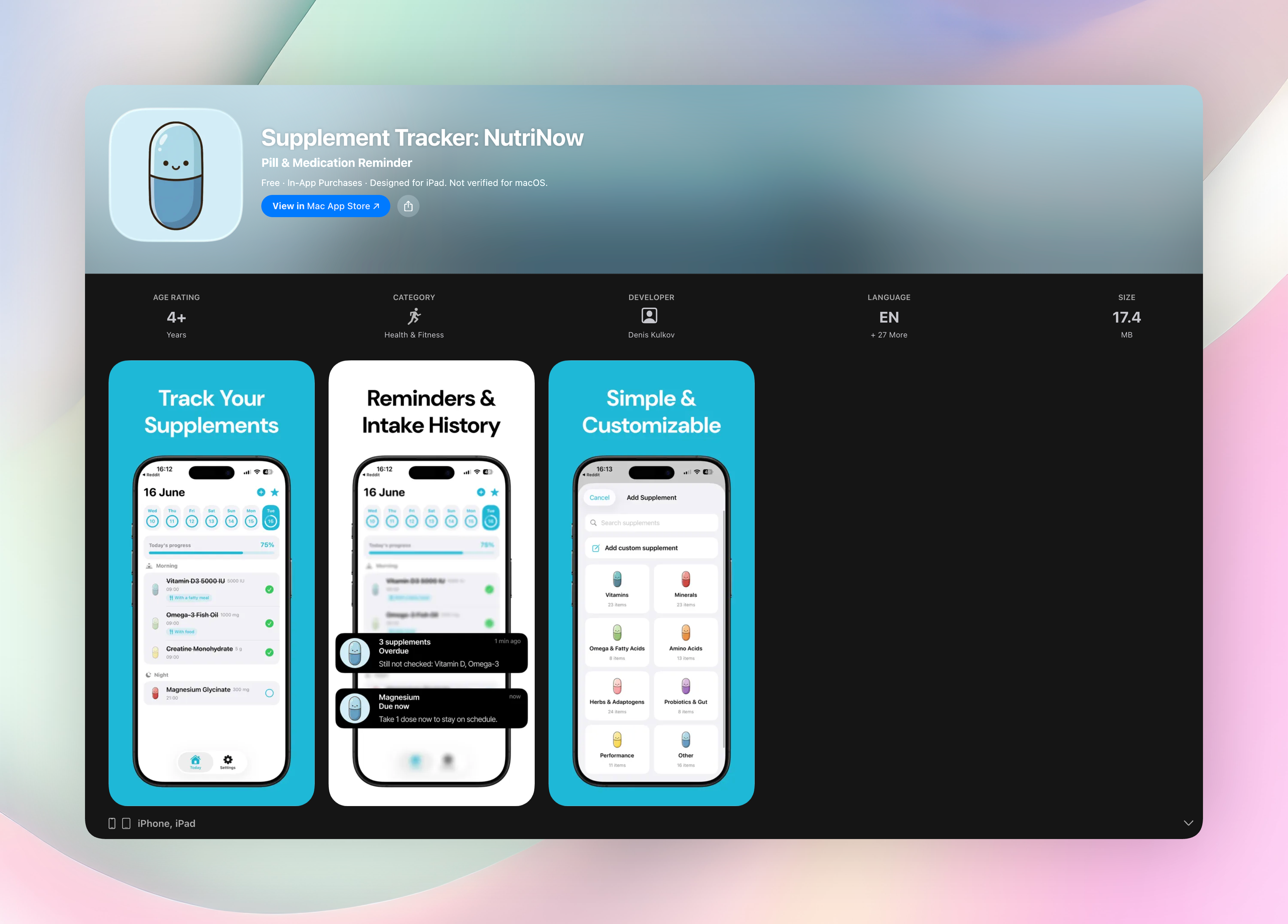
If sticking to that slot is the part that keeps slipping — not knowing whether you already took today's dose, or forgetting entirely on busier days — that's a logistics problem, not a willpower problem, and it's worth solving with a tool rather than a New Year's resolution. Supplement Tracker is a free app for adding your supplements, logging each dose with one tap, seeing a countdown to your next dose, setting reminders, and keeping a full intake history — no account required.
Fat-soluble vs. water-soluble: a quick reference
| Fat-soluble (A, D, E, K) | Water-soluble (B-complex, C) | |
|---|---|---|
| Take with food? | Yes — needs some dietary fat present | Optional, but often gentler on the stomach with food |
| Best time of day | Any meal with fat, morning or evening | Any time; morning is common for B-vitamins |
| What happens to excess | Stored in fat tissue and the liver | Not stored — excreted in urine |
| Missed-dose tolerance | Fine occasionally; body has some reserve | Fine occasionally; levels drop faster without stores |
Building a slot that actually survives your week
A few practical patterns that hold up better than a rigid "9am sharp" rule:
- Attach it to an existing habit, not a clock time. "After I pour my coffee" survives a chaotic Tuesday in a way "8:15am" doesn't.
- Keep the bottle where the habit happens. If breakfast is the anchor, the bottle lives on the kitchen counter, not in a bathroom cabinet two rooms away.
- Batch what you can. If you take several supplements, taking most of them in one sitting is simpler to remember than spreading five separate alarms through the day.
- Expect travel and weekends to break the pattern, and have a fallback slot (usually "before bed") rather than skipping the day entirely.
- Don't chase precision you can't verify. You don't need to hit a specific hour — you need to not skip days.
None of this requires giving up on timing advice that's genuinely useful (fat-soluble vitamins with food, spacing certain minerals apart) — it just means treating the clock-time question as far less important than the "did I actually take it today" question.
What about taking several supplements together?
If your routine covers more than one product — say a multivitamin, vitamin D, and magnesium — you don't need a separate time slot for each. Most people do fine taking their whole stack in one sitting, once or twice a day. The exceptions are pairs known to compete for absorption when taken in the exact same dose, like iron and calcium; spacing those by a couple of hours is a reasonable habit, not a strict requirement. Beyond that specific case, splitting your supplements across the day mostly adds more chances to forget one, not more benefit.
Where a routine tends to fall apart isn't the biology, it's the bookkeeping: which bottle you've already taken today, which one you're low on, and which one you meant to take an hour ago and now can't remember if you did. That's the part worth automating rather than trying to hold in your head.
FAQ
Is it better to take vitamins in the morning or at night?
For most vitamins, it doesn't meaningfully matter — pick the slot that fits your routine and stick with it. The main exceptions are fat-soluble vitamins (A, D, E, K), which absorb better with a meal containing some fat, regardless of whether that meal is breakfast or dinner.
Does taking vitamins at the same time every day matter?
Yes, more than the specific hour does. Nutrient levels build up over days and weeks, so a consistent daily habit does more for you than hunting for the theoretically optimal minute.
Should I take vitamins on an empty stomach?
Water-soluble vitamins (B, C) generally tolerate an empty stomach fine, though some people find any supplement easier on the stomach with a bit of food. Fat-soluble vitamins (A, D, E, K) specifically need some dietary fat present to absorb well, so pair those with a meal.
What if I forget and take my vitamins late?
Taking them later than usual on an occasional day is not a problem — take them when you remember, unless you're close to your next scheduled dose, in which case just resume your normal time the next day. The goal is a consistent pattern over weeks, not a perfect streak.
Free Supplement tools
- Vitamin IU to Mcg ConverterConvert a vitamin label quantity between IU and micrograms. Select the exact vitamin form because IU is a measure of biological activity and its mass conversion is not universal.
- Supplement PlannerTurn the supplement choices you have already made into a simple browser-based timetable. The planner organizes entries; it does not recommend doses or check interactions.