When to Take Creatine: Before, After, or Rest Days
Creatine timing matters far less than creatine consistency. Take it at roughly the same time every day — including rest days — and it'll build up in your muscles regardless of whether that's before or after your workout. The pre/post debate is mostly noise; daily habit is the real variable.
When to take creatine: before or after your workout
The most common question is whether creatine "works better" pre- or post-workout, and the honest answer is that the difference, if it exists at all, is small enough that it shouldn't be what decides your routine. Creatine doesn't act like a pre-workout stimulant — it's not going to hit your bloodstream and give you a burst of energy in the next twenty minutes. It works by saturating your muscle creatine stores over days and weeks, so what matters is that the dose goes in reliably, not which side of your training session it lands on.
If you want a tiebreaker: taking it with your post-workout meal or shake is a popular default because it's easy to remember — you're already eating something, so the creatine rides along. But taking it before your workout, with breakfast, or with dinner on a non-training day all work fine. Some lifters take it with a meal because a small amount of carbohydrate and protein alongside creatine may help with uptake, though this effect is modest and not something you need to engineer around.
Do you need to take creatine on rest days?
Yes. This trips people up because they mentally file creatine next to pre-workout — something you take before you train. It isn't. Creatine works by keeping your muscle stores topped up over time, and those stores don't pause just because you didn't lift that day. Skipping rest days means you're only getting five or six effective doses a week instead of seven, which slows how long it takes to reach and hold a saturated level.
The simplest fix is to anchor the rest-day dose to something else that happens every day regardless of training — breakfast, your morning coffee, a meal you eat no matter what. That removes the "did I train today" branch from the decision entirely.
Does creatine timing matter with food or on an empty stomach?
Creatine monohydrate is fairly forgiving here. It doesn't require food to be absorbed, and plenty of people take it in plain water with no issue. Taking it with a meal is common less because it's required and more because meals are a convenient, memorable anchor point, and a bit of food can ease the mild stomach discomfort some people report from creatine on a completely empty stomach.
Do you need a loading phase?
Loading — a higher dose for the first five to seven days, tapering down after — is an established method for reaching saturated muscle stores faster, but it isn't required. Taking a consistent daily amount without a loading phase gets you to the same saturated state, it just takes a few weeks longer to get there instead of about a week. For casual, ongoing use, most people skip loading and just start with their regular daily amount from day one — there's nothing wrong with either approach, it's a speed-versus-simplicity tradeoff, not a right-versus-wrong one. As always, the amount itself is a personal and label-specific decision, not something to copy from a forum post.
Building a creatine habit that actually holds up
Creatine is a "boring but consistent" supplement — the whole strategy is showing up daily, not timing any single dose with precision. A few things that help:
- Pick one anchor, not a workout-dependent one. "With breakfast" survives rest days and travel; "right after training" doesn't.
- Keep it in the same spot as something you already reach for daily — next to the coffee, in the gym bag if that's where breakfast happens.
- Don't stress about a missed day. One skipped dose barely dents saturated stores; a pattern of skipped days does.
- Track it if memory is the actual weak point, not the routine itself. If you genuinely can't recall whether you took today's dose, that's a logging problem, and it's easier to solve with a quick tap than by trying to remember harder.
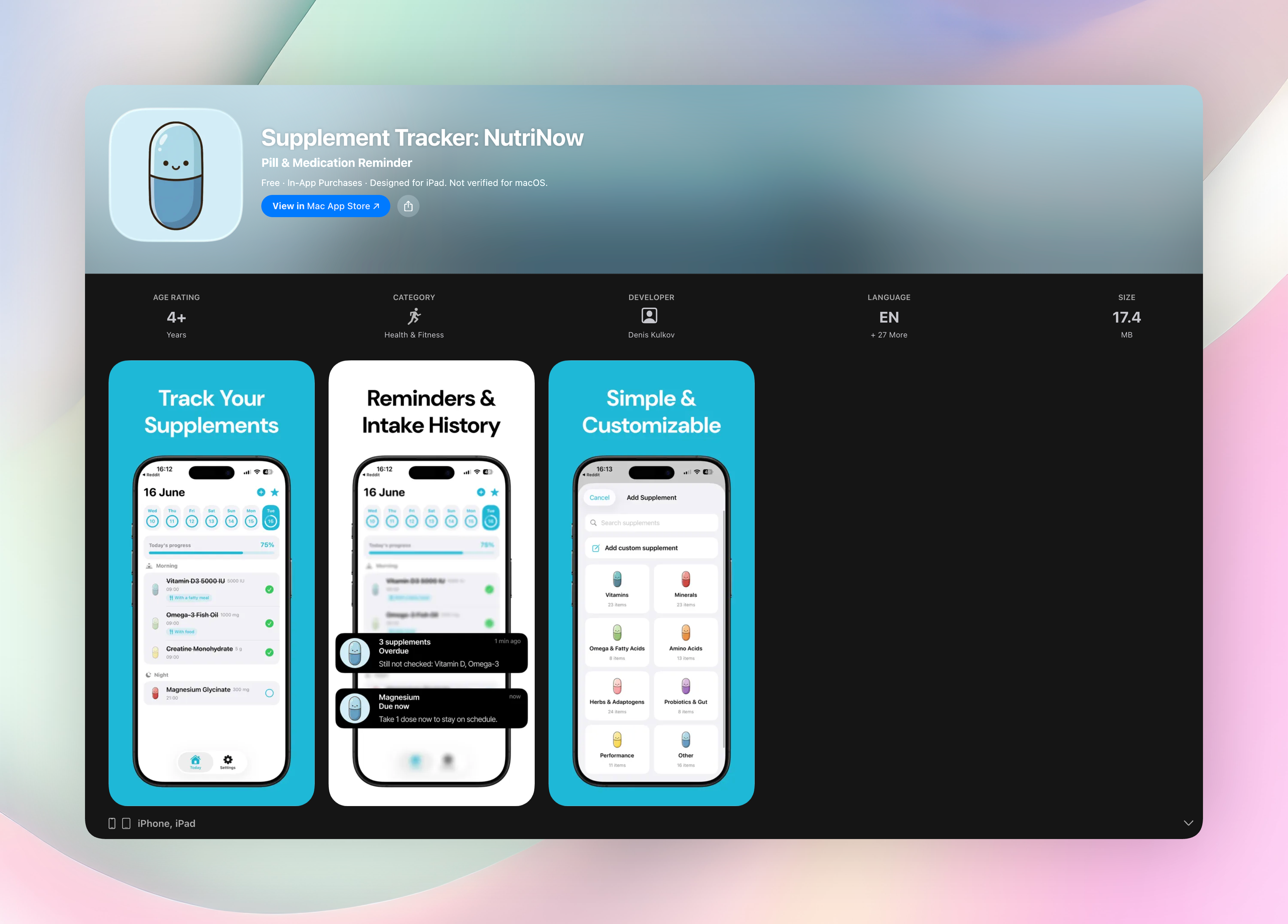
That last point is where a dedicated tracker earns its keep. Supplement Tracker is a free app for adding your supplements, logging each dose with one tap, seeing a countdown to your next dose, setting reminders, and keeping a full intake history — no account required — useful for a daily-no-matter-what supplement like creatine specifically because it doesn't care whether today is a training day.
If you're still deciding how to build supplement timing into your day more broadly, when is the best time to take vitamins covers the same consistency-over-precision logic for the rest of your stack.
FAQ
Is it better to take creatine before or after a workout?
The difference between pre- and post-workout timing is small and not well established as meaningfully better either way. What matters far more is taking it every day, including rest days, since creatine works by saturating muscle stores over time rather than acting in the moment.
Do I need to take creatine on days I don't work out?
Yes. Creatine maintains muscle stores over the full week, not just on training days. Skipping rest-day doses is the most common way people accidentally undercut their own consistency.
Can I take creatine on an empty stomach?
Yes, creatine monohydrate doesn't require food to be absorbed. Some people prefer taking it with a meal for stomach comfort or simply because it's easier to remember alongside eating.
Do I need to do a loading phase with creatine?
No. A loading phase gets you to saturated muscle stores faster — in about a week instead of a few weeks — but a steady daily amount from day one reaches the same place eventually. Which to use is a personal choice about speed versus simplicity, not a requirement.
Free Supplement tools
- Vitamin IU to Mcg ConverterConvert a vitamin label quantity between IU and micrograms. Select the exact vitamin form because IU is a measure of biological activity and its mass conversion is not universal.
- Supplement PlannerTurn the supplement choices you have already made into a simple browser-based timetable. The planner organizes entries; it does not recommend doses or check interactions.