
Should I Take Vitamins With Food? The Real Rule
Fat-soluble vitamins (A, D, E, K) absorb better with a meal that has some fat in it. Water-soluble ones (B, C) are more flexible either way. Beyond absorption, food also softens stomach upset for a lot of people, which is often the more practical reason to take vitamins with a meal.
Should I take vitamins with food: the short version
The honest rule of thumb splits supplements into two rough camps. Fat-soluble vitamins — A, D, E, and K — dissolve into dietary fat during digestion, so a meal containing some fat measurably helps your body absorb them. Water-soluble vitamins — the B-complex and vitamin C — dissolve in water instead, absorb reasonably well with or without food, and anything your body doesn't use gets flushed out rather than stored. Minerals don't split as cleanly, but several of them (iron, zinc, magnesium) have their own food-related considerations that are more about stomach comfort or absorption efficiency than a strict requirement.
Why food helps some vitamins absorb better
The fat-soluble mechanism is straightforward: vitamins A, D, E, and K need to be carried through digestion attached to fat molecules. Take one of them with a completely fat-free, food-free glass of water, and a meaningful share of the dose passes through without being absorbed efficiently. Take the same capsule alongside eggs, dairy, nut butter, olive oil, or avocado, and absorption improves. You don't need a large or specifically calculated amount of fat — a normal meal that isn't fat-free covers it.
Water-soluble vitamins don't have this issue, which is why B-complex supplements are commonly recommended on an empty stomach in the morning without much controversy — there's no absorption penalty for skipping food.
Why food helps even when absorption isn't the issue
Separate from absorption, plenty of supplements are simply easier on the stomach with food in it. Iron and zinc both have reputations for causing nausea when taken on a completely empty stomach — that's a comfort issue, not an absorption one, and it's the more common reason people are told to "take with food" even for supplements where the science on absorption improvement is thinner. If a supplement upsets your stomach on an empty stomach, taking it with even a light snack is worth trying before assuming the supplement itself doesn't agree with you.
Can you take vitamins on an empty stomach?
For water-soluble vitamins, yes, generally without a downside. For fat-soluble vitamins, you can, but you're leaving some absorption on the table, so it's worth building the habit of pairing them with a meal when you reasonably can. For anything you know tends to upset your stomach — iron and zinc being the usual suspects — an empty stomach is more likely to cause discomfort than to meaningfully improve results, so food is the more practical default there too.
| Nutrient type | With food? | Why |
|---|---|---|
| Fat-soluble (A, D, E, K) | Recommended | Needs dietary fat present to absorb well |
| Water-soluble (B, C) | Optional | Absorbs fine either way; food may ease stomach sensitivity |
| Iron, zinc | Recommended | Mainly for stomach comfort, not absorption |
| Magnesium | Recommended | Mainly for stomach comfort with larger amounts |
Building the habit either way
Whether your supplement needs food or not, tying it to a specific meal is still the easiest way to keep it consistent — "with breakfast" is a slot you already have, unlike a bare clock time. The trickiest part in practice isn't remembering to eat, it's remembering which of your supplements are meal-dependent and which aren't, especially once you're taking more than two or three.
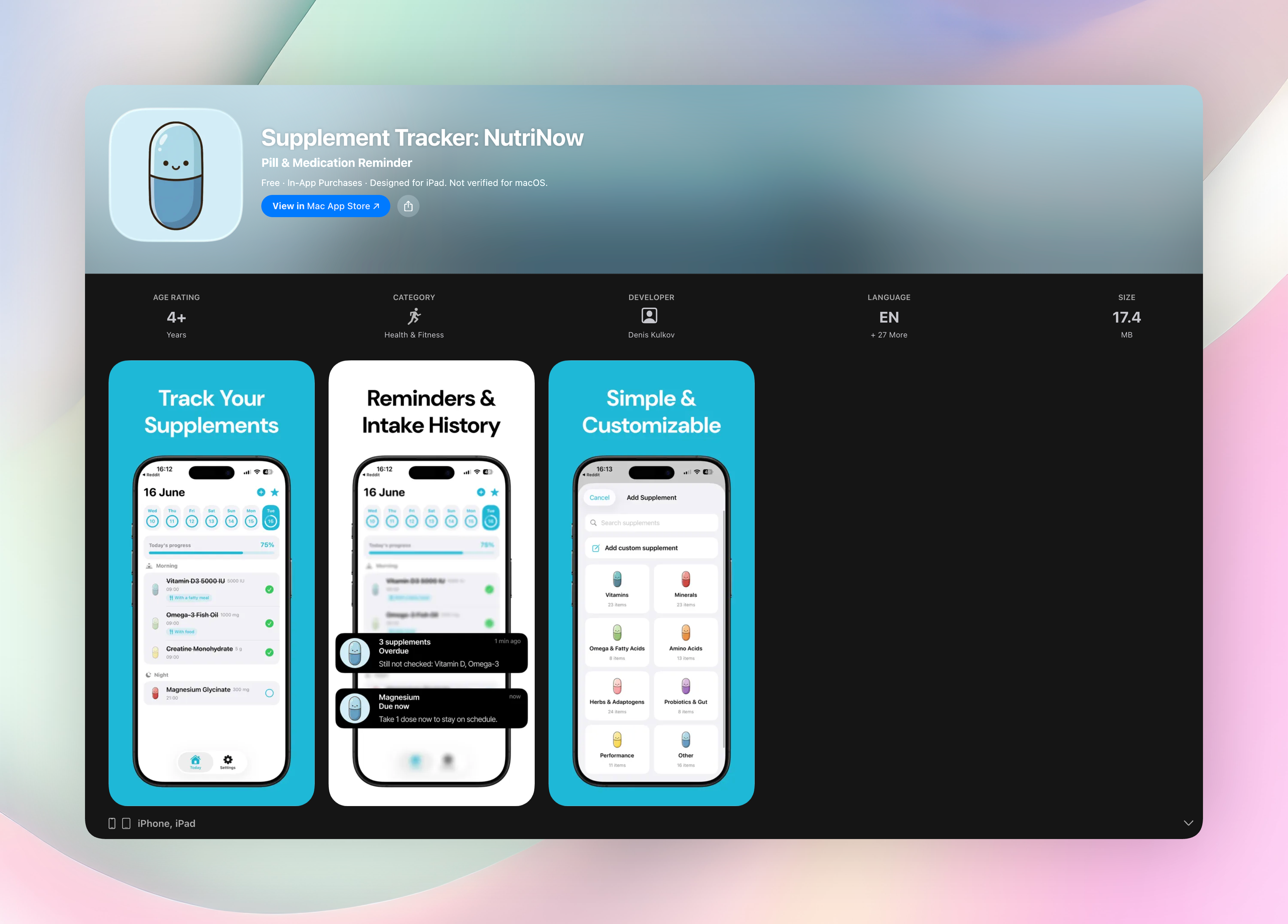
That's a reasonable thing to offload rather than keep memorized. Supplement Tracker is a free app for adding your supplements, logging each dose with one tap, seeing a countdown to your next dose, setting reminders, and keeping a full intake history — no account required, so you can note per-supplement details like "with breakfast" once and stop relying on memory for it.
This food-pairing logic is the same one covered in more depth for vitamin D and iron specifically, and it ties into the broader consistency principle in when is the best time to take vitamins.
FAQ
Which vitamins need to be taken with food?
Fat-soluble vitamins — A, D, E, and K — absorb better with a meal that contains some dietary fat. Water-soluble vitamins like B and C don't have this requirement, though food can still help with stomach comfort.
Can you take vitamins on an empty stomach?
Water-soluble vitamins are generally fine on an empty stomach. Fat-soluble vitamins can be taken that way too, but you'll absorb less of the dose, so pairing them with food is the better habit when it's practical.
Why do some supplements upset my stomach without food?
Certain supplements, iron and zinc especially, are more likely to cause nausea when taken on a truly empty stomach. This is a comfort issue rather than an absorption one, and taking them with even a light snack usually helps.
Does it matter how much fat is in the meal?
Not precisely — you don't need to calculate an amount. A normal meal that isn't completely fat-free, like eggs or a splash of milk in coffee, is generally enough to help fat-soluble vitamins absorb.
Free Supplement tools
- Vitamin IU to Mcg ConverterConvert a vitamin label quantity between IU and micrograms. Select the exact vitamin form because IU is a measure of biological activity and its mass conversion is not universal.
- Supplement PlannerTurn the supplement choices you have already made into a simple browser-based timetable. The planner organizes entries; it does not recommend doses or check interactions.