
Weekly Pill Organizer: How to Set One Up and Use It
A weekly pill organizer works best when you set it up as a single Sunday task: fill all seven days at once, label each compartment by AM/PM if you split doses, and store it somewhere you'll actually see it daily. The habit fails most often at refilling, not at using it.
Choosing a weekly pill organizer
Weekly organizers come in a few basic shapes, and the right one depends on how many separate doses you're managing rather than how many pills you take:
- Simple 7-day, one-compartment-per-day — fine if you take everything in a single daily dose.
- 7-day AM/PM — one row for morning, one for evening, useful the moment you split anything (like taking magnesium at night and everything else in the morning).
- 7-day with three or four slots per day — for more complex routines, spread across morning, midday, evening, and bedtime.
Bigger isn't automatically better. A four-slot-per-day organizer for someone taking two supplements once a day is more container than the routine needs, and more compartments generally means more chances to leave one empty by mistake. Match the organizer's complexity to your actual routine, not to the biggest one on the shelf.
How to set up a 7-day AM/PM organizer
- Lay out everything you take first, sorted by which slot it belongs in — morning, evening, or both. This is also the moment to catch spacing issues, like keeping iron and calcium out of the same compartment if you take both.
- Fill one day at a time, left to right, rather than doing all the morning slots first and then all the evening slots. It's easier to catch a missed pill mid-row than at the end of a full pass.
- Label the case if it doesn't come pre-labeled, especially the AM/PM distinction — a blank grid of 14 compartments is surprisingly easy to lose track of by Thursday.
- Do the whole week in one sitting. Splitting the fill-up across multiple days is where organizers most often go half-empty.
- Pick a consistent refill day — Sunday evening is common because it's before the week starts, not in the middle of it.
Where to keep your pill organizer
Visibility does most of the work here. An organizer in a drawer gets forgotten the same way a loose bottle does; an organizer sitting next to the coffee maker, on the bathroom counter by the toothbrush, or on the kitchen table gets used because you can't avoid seeing it. If you split AM and PM, it can help to have the organizer live wherever your morning routine happens and simply carry the evening row's pills with you, or keep a second, smaller PM-only case somewhere your evening routine happens instead.
The common failure mode: forgetting to refill it
Most people who give up on a pill organizer don't quit because using it is hard — they quit because it goes empty on a Thursday and nobody notices until Saturday, at which point the whole week feels shot and it's easier to abandon the system than to catch up mid-week. A few ways to catch this before it happens:
- Refill on the same day every week, treated like a recurring errand rather than "whenever I remember."
- Do a visual check on day 5 or 6 — if Friday's slot still looks full on Wednesday, something's off with your routine, not just the organizer.
- Keep a backup week's worth of pills nearby so an empty organizer on a Thursday is a five-minute refill, not a missed few days while you restock.
A digital alternative for the same problem
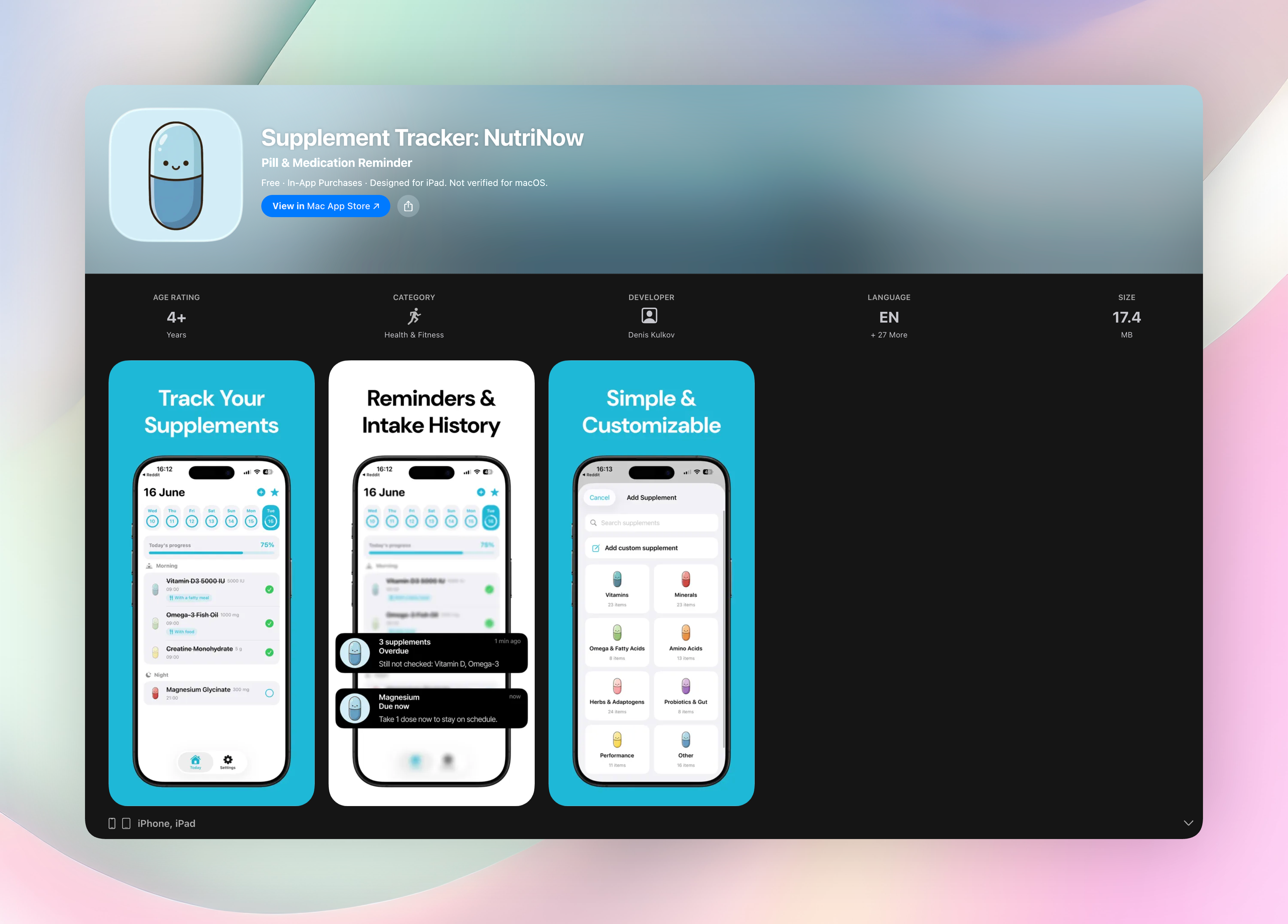
A physical organizer solves a specific problem: knowing at a glance whether today's dose is already sorted. A digital tracker solves the same problem without the plastic case, which matters more if you travel often, don't like pre-sorting pills into a grid, or take supplements that don't fit neatly into a 7-day box (irregular schedules, "every other day" items, or things you're only taking for a few weeks). Supplement Tracker is a free app for adding your supplements, logging each dose with one tap, seeing a countdown to your next dose, setting reminders, and keeping a full intake history — no account required. For some people it replaces the organizer entirely; for others it's a way to double-check the physical box without opening every compartment.
Whichever system you use, the underlying habit is the same one covered in when is the best time to take vitamins: a consistent daily slot matters more than precise timing. And if iron or calcium are part of your weekly fill-up, when to take iron supplements covers how to space those compartments out.
FAQ
How do I organize my supplements in a weekly pill organizer?
Lay out everything by which slot it belongs in first (morning, evening, or both), then fill one full day at a time, left to right, rather than doing all mornings and then all evenings. Label the AM/PM rows if the case doesn't come labeled.
What size pill organizer should I get?
Match it to your actual routine — a simple one-compartment-per-day case if you take everything at once, or an AM/PM split if you take supplements at two different times. More slots than you need just adds more chances to leave one empty by mistake.
How often should I refill my pill organizer?
Weekly, on a fixed day, is the easiest pattern to maintain — treat it as a recurring task rather than something you do "whenever it's empty." An empty organizer that isn't refilled promptly is the most common reason people abandon the habit.
Is a digital supplement tracker better than a pill organizer?
They solve overlapping problems in different ways — a physical organizer gives you an at-a-glance visual, while a digital tracker handles irregular schedules and doesn't require pre-sorting pills. Plenty of people use both together rather than picking one.
Free Supplement tools
- Vitamin IU to Mcg ConverterConvert a vitamin label quantity between IU and micrograms. Select the exact vitamin form because IU is a measure of biological activity and its mass conversion is not universal.
- Supplement PlannerTurn the supplement choices you have already made into a simple browser-based timetable. The planner organizes entries; it does not recommend doses or check interactions.