
How Many Supplements Can You Take at Once?
Most people can take their full supplement stack in one sitting without an issue. Order rarely matters for common combinations, and spacing only helps in a handful of specific cases — mainly stomach comfort or a known absorption overlap like iron and calcium. A simple morning/evening split beats overthinking the sequence.
How many supplements can you take at once
There's no universal cap on how many supplements you can take in the same sitting — the real constraints are stomach tolerance and the handful of known interactions, not some general rule about not mixing too many at once. If you're taking, say, a multivitamin, vitamin D, and magnesium, there's nothing wrong with taking all three together. The exceptions are supplements known to compete for absorption in meaningfully large amounts (iron and calcium being the clearest example) or ones that are individually rough on an empty stomach (iron and zinc), where spacing or food-pairing matters more than the total count.
Does the order you take supplements in matter?
For most combinations, no. There's no established benefit to taking your multivitamin before your magnesium, or your vitamin D after your probiotic instead of before it. Order becomes relevant mainly in the specific cases where one supplement's absorption depends on something in another — the iron-and-calcium overlap again being the standard example — and even then, the fix is spacing them apart in time, not sequencing them in a particular order within the same sitting.
How long should you wait between supplements?
For most pairs, you don't need to wait at all. The "wait between supplements" advice really only applies to known competing pairs — iron and calcium, and to a lesser extent iron and zinc if taken in large individual amounts. A couple of hours of separation is a reasonable habit for those specific combinations. For everything else — a standard multivitamin, vitamin D, magnesium, a B-complex, probiotics — taking them together in one sitting is fine and, for most people, easier to remember than spacing everything out across the day.
| Situation | Take together? | Notes |
|---|---|---|
| Multivitamin + vitamin D + magnesium | Yes | No known interaction; common to combine |
| Iron + calcium (or a calcium-rich meal) | Space apart | Compete for absorption; a couple hours helps |
| Iron + zinc, in larger individual amounts | Space apart if possible | Similar competing-absorption concern |
| Probiotic + everything else | Depends on the probiotic | Check the label for its own food/timing instructions |
Simplify with an AM/PM split
Rather than trying to sequence a growing stack, most people do better with a two-slot system: a morning group and an evening group, decided once and then repeated daily. This solves the ordering question by making it irrelevant — within a slot, the specific sequence you take things in doesn't matter, only which slot each supplement lives in. It also naturally handles the iron/calcium spacing problem if you keep the two on opposite sides of the day rather than trying to remember to wait a precise number of hours within the same slot.
A useful default: put anything with a genuine reason to be taken with food (fat-soluble vitamins, iron, zinc) into whichever slot has a reliable meal attached, and put anything flexible (many B-vitamins, magnesium if you don't have stomach issues with it) wherever it's easiest to remember.
Keeping a growing stack straight
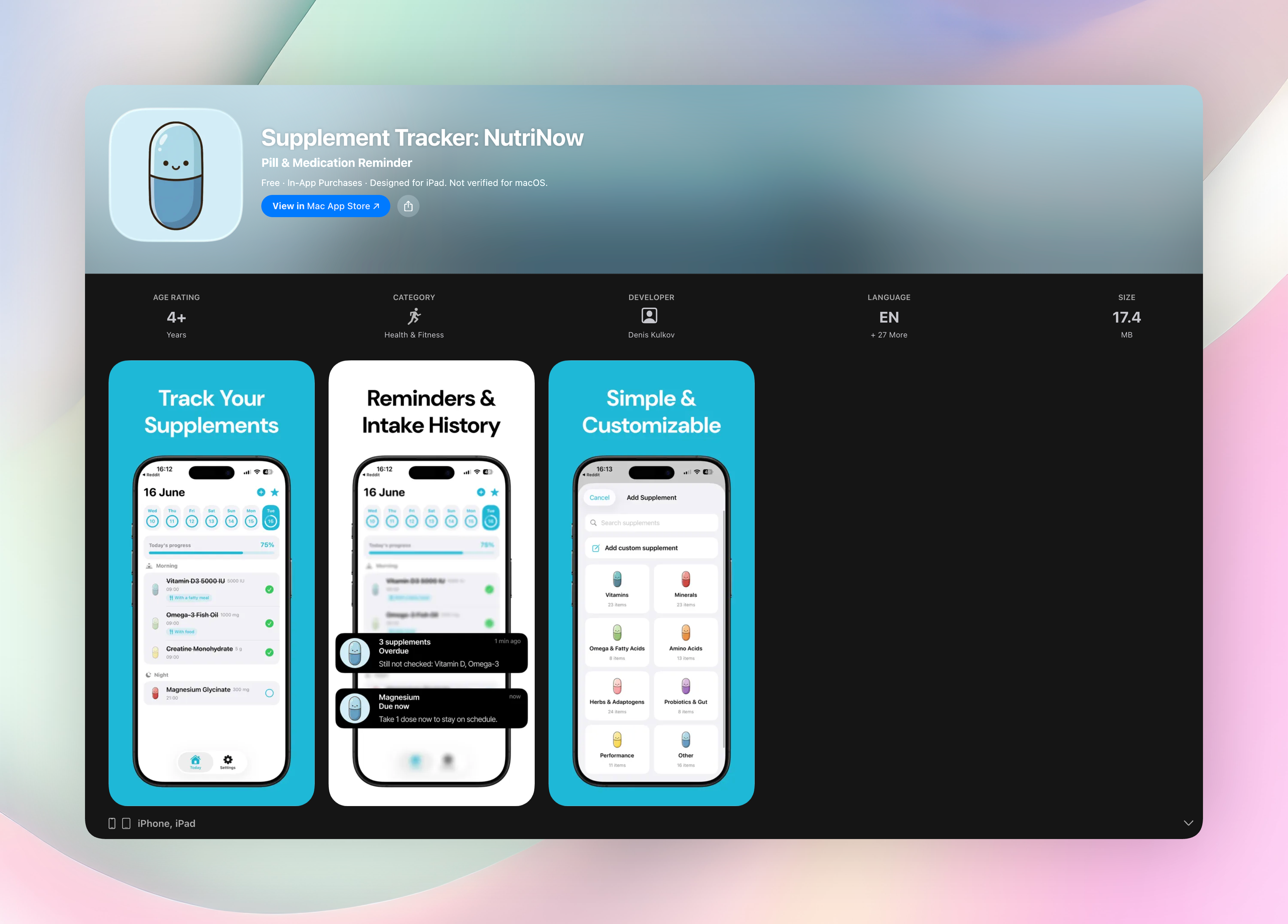
The more supplements you add, the easier it is to lose track of which ones you've already taken today, and which pairs you were supposed to keep apart. That's less a memory challenge and more a bookkeeping one, and it's worth treating it that way rather than trying to hold a growing mental checklist. Supplement Tracker is a free app for adding your supplements, logging each dose with one tap, seeing a countdown to your next dose, setting reminders, and keeping a full intake history — no account required, so a five-supplement stack is as easy to keep straight as a one-supplement routine.
The iron-and-calcium spacing point comes up again in when to take iron supplements, and the general principle of picking one consistent slot per supplement is covered in when is the best time to take vitamins.
FAQ
Is it safe to take multiple supplements at the same time?
For most common combinations, yes — there's no general rule against taking several supplements together. The main exceptions are pairs known to compete for absorption, like iron and calcium, which benefit from being spaced a couple of hours apart.
Does the order I take my supplements in matter?
Not for most combinations. Order only becomes relevant for the small number of known interactions, and even then the fix is spacing them apart in time rather than choosing a specific sequence.
How long should I wait between iron and calcium?
A couple of hours of separation is a reasonable habit, since the two compete for the same absorption pathway when taken together. Outside of specific pairs like this one, most supplements don't need any waiting period between them.
What's the easiest way to organize a growing supplement stack?
A simple morning/evening split works well for most people — decide once which supplements belong in which slot, then repeat that daily instead of re-deciding the order each time.
Free Supplement tools
- Vitamin IU to Mcg ConverterConvert a vitamin label quantity between IU and micrograms. Select the exact vitamin form because IU is a measure of biological activity and its mass conversion is not universal.
- Supplement PlannerTurn the supplement choices you have already made into a simple browser-based timetable. The planner organizes entries; it does not recommend doses or check interactions.