How to Remember to Take Your Vitamins Every Day
How to remember to take vitamins comes down to one tactic that works reliably: habit-stacking — attach the dose to something you already do without thinking, like brushing your teeth or making coffee. Visual cues and reminders help too, but they're a backup for when that anchor habit gets disrupted.
How to remember to take vitamins: why forgetting happens first
Forgetting isn't a discipline problem — it's a design problem. Vitamins usually don't produce an immediate feeling, good or bad, so there's no built-in signal reminding you that today's dose is overdue the way hunger reminds you to eat. Add to that a bottle stored somewhere out of sight, a routine with no fixed anchor point, and a schedule that changes slightly every day, and forgetting becomes the default outcome, not the exception. The people who stay consistent aren't relying on stronger willpower — they've built a routine where forgetting is genuinely harder than remembering.
Habit-stacking: the tactic that actually works
Habit-stacking means attaching a new behavior to an existing one that already happens automatically, so the new behavior rides along without needing its own dedicated memory slot. For supplements, that usually looks like:
- Next to the coffee maker or kettle — take your vitamins while the coffee brews.
- By the toothbrush — right after brushing, morning or night.
- With a specific meal — the same one every day, not "whenever I eat."
- Plugging in your phone at night — a natural evening anchor for anything you take before bed.
The anchor habit has to be something you genuinely do every single day without exception — that's what makes it reliable. An anchor like "after my workout" fails on rest days; "after I brush my teeth" doesn't.
Visual cues: making forgetting harder, not just remembering easier
A bottle in a cabinet is invisible by design — you only see it if you were already thinking about it, which defeats the purpose. Moving the bottle (or a pill organizer) somewhere you can't avoid seeing — the kitchen counter, next to your keys, on the bathroom sink — does more work than any amount of willpower. The goal isn't a decorative reminder, it's an obstacle: something in your line of sight that you have to consciously ignore in order to skip today's dose.
When habit-stacking isn't enough
Habit-stacking works well until the anchor habit itself gets disrupted — travel, a schedule change, a stretch of days where your morning routine falls apart. That's the gap reminder apps and trackers are built for: a nudge that doesn't depend on your normal routine holding together, plus a record of what you actually did instead of what you think you did. It's also useful simply for tracking whether you already took today's dose, since "did I take this already?" is one of the most common reasons people either double up or skip entirely.
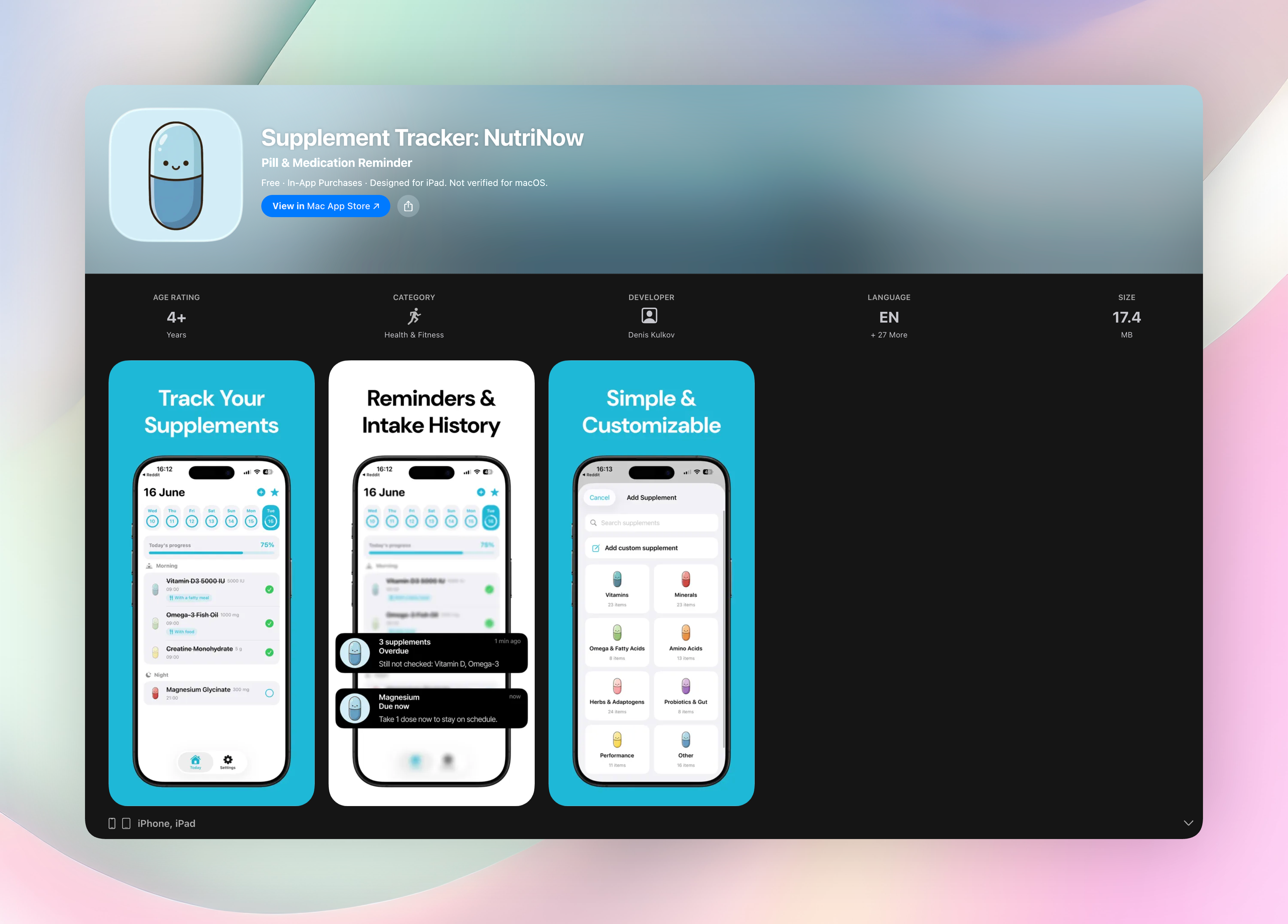
Supplement Tracker is a free app for adding your supplements, logging each dose with one tap, seeing a countdown to your next dose, setting reminders, and keeping a full intake history — no account required, which covers both problems: a reminder for the days your routine breaks, and a countdown so you're never guessing whether you already took something.
Building a supplement habit that survives disruption
A few things that make the difference between a habit that holds up and one that falls apart the first bad week:
- Pick an anchor with zero exceptions — something you do on weekends, sick days, and travel days too, not just a normal Tuesday.
- Keep a backup slot. If your morning anchor gets skipped, have a fallback (often "before bed") rather than treating the day as a loss.
- Don't punish a missed day by trying to catch up with a double dose — just resume your normal amount at the next scheduled time.
- Review the pattern occasionally, not just individual days. One missed Tuesday is nothing; missing every Tuesday for a month means your anchor habit doesn't actually happen on Tuesdays.
None of this requires a complicated system — the goal is removing decisions, not adding them. The fewer times a day you have to consciously remember "did I take my vitamins," the more likely the answer stays yes.
For the broader logic behind why consistency matters more than precise timing, see when is the best time to take vitamins. And if a weekly organizer is part of your setup, the pill organizer guide covers how to keep that system from going empty unnoticed.
FAQ
Why do I keep forgetting to take my vitamins?
Usually because there's no natural cue reminding you — vitamins don't produce an immediate feeling, and a bottle tucked in a cabinet is easy to overlook. Attaching the dose to an existing daily habit, and keeping it somewhere visible, fixes most of the problem.
What is habit-stacking and how does it help with supplements?
Habit-stacking means pairing a new habit with one you already do automatically, like brushing your teeth or making coffee, so the new behavior rides along without needing its own memory slot. It works best when the anchor habit happens every single day without exception.
Are reminder apps actually effective for supplements?
They're most useful as a backup for when your normal routine gets disrupted — travel, a schedule change, a rough week — rather than a replacement for a good habit anchor. They're also useful just for tracking whether you already took a dose, which prevents both skipped and doubled doses.
How long does it take to build a consistent vitamin habit?
There's no fixed number that applies to everyone, and forming a reliable habit varies a lot by person and routine. What matters more than a specific timeline is choosing an anchor you genuinely do every day, since that's what turns the habit automatic rather than effortful.
Free Supplement tools
- Vitamin IU to Mcg ConverterConvert a vitamin label quantity between IU and micrograms. Select the exact vitamin form because IU is a measure of biological activity and its mass conversion is not universal.
- Supplement PlannerTurn the supplement choices you have already made into a simple browser-based timetable. The planner organizes entries; it does not recommend doses or check interactions.