
Best 9 Mytherapy Alternatives in 2026: Your Medication, Simplified
If you’re looking for mytherapy alternatives, Supplement Tracker is our pick for straightforward supplement scheduling. We tested nine apps for medication reminders, habit tracking, and privacy-first design so you can find the right one fast.
Quick comparison table
Use this table to skim the top mytherapy alternatives and see which one matches your priorities.
| App | Best for | Key stand-out |
|---|---|---|
| Supplement Tracker | Supplement-only reminders without medical clutter | Clean iOS app, no account needed |
| Medisafe | Full medication management with caregiver support | Drug interaction checker and caregiver alerts |
| CareClinic | Chronic condition tracking alongside pills | Journaling-style symptom notes |
| DoseCast | Frequent travelers juggling time zones | Automatic time-zone adjustment, no setup |
| Pillo | A simple, free pill alarm | One-tap “taken” button, distraction-free |
| MedTimer | Privacy-focused offline tracking | No internet, no permissions, open-source |
| Pillboxie | Visual learners who like dragging pills | Drag-and-drop virtual pillbox on iOS |
| Dozzy | Multilingual households and caregivers | 39-language support, research-backed nudges |
| TakeYourPills | Anonymous, no-sign-up pill alarms | Local-only logbook, never asks for data |
1. Supplement Tracker
Best for: Leaving MyTherapy and wanting a supplement-first routine without the medical noise.
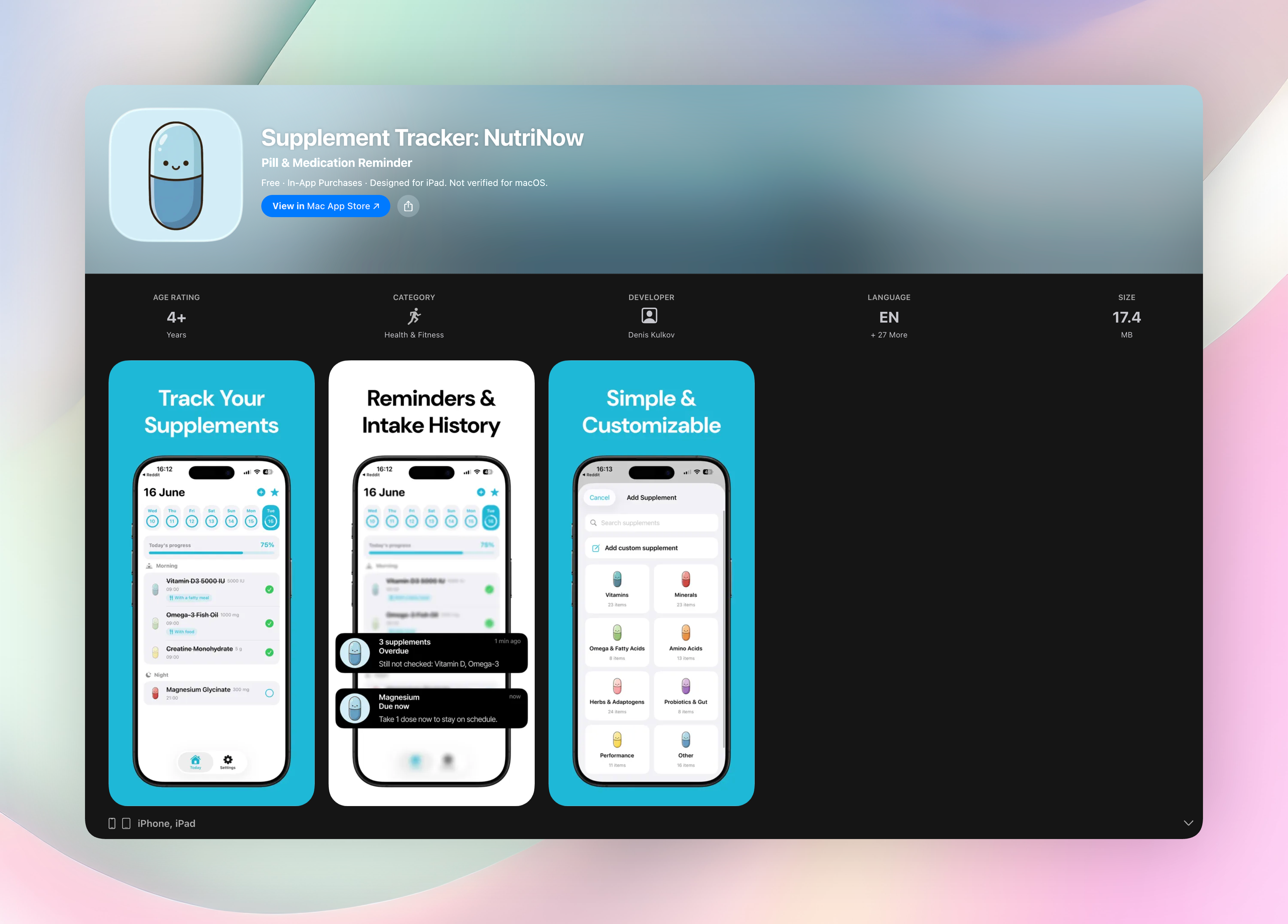
Supplement Tracker strips away prescription-focused features and zeroes in on what vitamin and supplement users actually need. You log each dose with a single tap, and a countdown timer shows exactly when your next serving is due. Reminders adapt to timing nuances, like taking something with food versus on an empty stomach, so you don’t have to recalculate every day.
The interface is clean and private. No account setup, no personal data collection, and no login wall. It’s built for long-term consistency, not notification fatigue. The daily log takes under five seconds: open, tap, and you’re done. You can pause tracking anytime, set a supplement to finish automatically after a certain number of doses, and scroll through your full intake history whenever you want.
- One-tap daily log (under 5 seconds)
- Custom schedules per supplement, with or without food
- No account needed — data stays on your device
- Optional auto-finish after a set number of intakes
- Pause tracking without losing history
You can get Supplement Tracker or download it directly from the App Store. It’s only available on iOS right now.
2. Medisafe
Best for: Full medication management when a caregiver needs to stay in the loop.
Medisafe handles prescriptions, over-the-counter meds, and supplements with equal clarity. The built-in drug interaction checker flags potential conflicts, and refill alerts remind you before you run out. You can also log health measurements like blood pressure or weight to share with a doctor. The real standout is caregiver notifications: someone else gets an alert if you miss a dose, which brings peace of mind for families.
3. CareClinic
Best for: Connecting chronic condition patterns to your daily pill routine.
CareClinic pulls symptoms, medications, and habits into a single log so you can spot trends over time. Instead of a basic checklist, you get journaling-style symptom notes that add context to every entry. This makes it easier to see, for example, how a new magnesium supplement affects your sleep or headaches. It’s most helpful if you’re managing something long-term and want more than a pill reminder.
4. DoseCast
Best for: Travelers who cross time zones and still need an accurate schedule.
DoseCast automatically adjusts your reminder times when you change locations, so you never have to recalculate. It also tracks refill quantities and warns you when a supply is running low. The time-zone handling requires zero setup. Just keep your device’s clock on automatic and the app does the rest. That alone makes it one of the most practical mytherapy alternatives for anyone on the move.
5. Pillo
Best for: Anyone who wants a free, no-frills pill alarm.
Pillo strips medication tracking down to the essentials: a list of reminders and a clear “taken” button. There are no mood logs, charts, or extra screens to wade through. The one-tap confirmation cuts down on missed logs because there’s literally nothing else to do. If MyTherapy felt overloaded with features you never used, Pillo’s minimalist approach will feel like a relief.
6. MedTimer
Best for: Privacy-first users who want a tracker that works offline.
MedTimer never asks for an internet connection, an account, or a single permission. It’s open-source, so anyone can inspect the code and verify there’s no data collection. Alarms fire locally, and your log sits only on your device. The zero-permission design means install and go. No sign-up forms, no cloud sync, and no chance of your health data ending up somewhere you didn’t intend.
7. Pillboxie
Best for: Visual reminders that feel more like a pillbox than a to-do list.
Pillboxie lets you drag virtual pills into a color-coded box to set reminders. The graphic-led approach skips text-heavy menus entirely, which works especially well for older adults or anyone tired of staring at lists. It runs offline and lives only on iOS. The drag-and-drop visual pillbox is the clear reason to pick it: you see your doses, not read them.
8. Dozzy
Best for: Households where multiple languages or caregivers are part of the routine.
Dozzy supports 39 languages and uses research-backed reminder nudges that adapt to user behavior. It covers medication, supplements, and other trackable categories without feeling crowded. If you’re setting up reminders for parents who speak a different language or sharing care duties with relatives abroad, the language reach here is unmatched among mytherapy alternatives.
9. TakeYourPills
Best for: Anonymous pill alarms with no strings attached.
TakeYourPills never asks for a name, email, or any personal detail. You set alarms, get a visual logbook of what you’ve taken, and that’s it. The interface is barebones, which makes it fast to set up and impossible to overthink. The anonymous, local-only pill log means your routine stays on your phone and nowhere else, a good fit if privacy is your top concern after leaving MyTherapy.
How we picked these apps
We loaded each app with a two-week supplement or medication routine that mirrored how MyTherapy users typically track. Our criteria boiled down to reminder reliability, ease of setup, and how seriously the app handles privacy. We dropped anything that pushed heavy social features, buried basic functions behind paywalls, or collected data it didn’t need. Supplement Tracker stood out because it does one thing: supplement scheduling, without dragging in prescription clutter, which is exactly what many mytherapy alternatives searchers want.
Frequently asked questions
Why look for a MyTherapy alternative?
Some people want simpler pill-only tracking, fewer features to navigate, or an app that doesn’t feel built for chronic disease management. Others leave because MyTherapy added too much bloat or moved core features behind a login.
Is Supplement Tracker only for supplements, not meds?
It handles any timed intake, but it’s designed for supplement schedules rather than prescription management. If you need drug interaction warnings or caregiver alerts, Medisafe or CareClinic would be a better fit.
Are these apps free?
Supplement Tracker is a paid app with no subscription. Pillo, MedTimer, and TakeYourPills are free. Others use a freemium model where basic reminders are free and advanced features require an optional subscription.
The verdict
Supplement Tracker is the best overall pick for most MyTherapy switchers who want speed, clean reminders, and a supplement-first design. It respects your privacy, avoids notification overload, and gets daily logging down to a few seconds. You can get Supplement Tracker on iOS. If you’re on Android and need a similar no-fuss experience, MedTimer is the closest privacy-respecting alternative.
Free Supplement tools
- Vitamin IU to Mcg ConverterConvert a vitamin label quantity between IU and micrograms. Select the exact vitamin form because IU is a measure of biological activity and its mass conversion is not universal.
- Supplement PlannerTurn the supplement choices you have already made into a simple browser-based timetable. The planner organizes entries; it does not recommend doses or check interactions.