
Best 9 Vitatrack Alternatives in 2026: Apps That Get Supplement Tracking Right
Introduction
If you’re after vitatrack alternatives, Supplement Tracker is the one that keeps you on schedule without fuss. We tested nine apps that all help you log, track, and understand your daily vitamins. Each serves a slightly different need, so you can zero in on the right one fast.
Quick comparison table
| App | Best for | Platform | Price | Standout feature |
|---|---|---|---|---|
| Supplement Tracker | No-fuss daily reminders | iOS | Freemium | Custom smart reminders |
| SuppCo | Verifying supplement quality before buying | iOS | Freemium | Independent brand-scoring system |
| Vitamin Tracker App | Offline privacy on Android | Android | Free | Fully local storage, no account needed |
| SuppTrack | Ingredient-level intake totals | iOS | Freemium | Ingredient-total dashboard |
| Nutrilio | Linking supplements to overall diet | Android | Freemium | Weekly nutrient trend reports |
| SuppWise | AI-driven personalized guidance | iOS | Freemium | AI nutrition coach |
| Cronometer | Micronutrient-obsessed tracking | Android | Freemium | Deep micronutrient breakdowns |
| Supplements AI – Stack Tracker | Ultra-clean stack logging | iOS | Freemium | Clutter-free single-purpose design |
| MyNetDiary | Calorie counting with vitamin tracking | Android | Freemium | Merged diet-and-supplement nutrient analysis |
1. Supplement Tracker
Best for: people who just want to remember every dose without complexity.
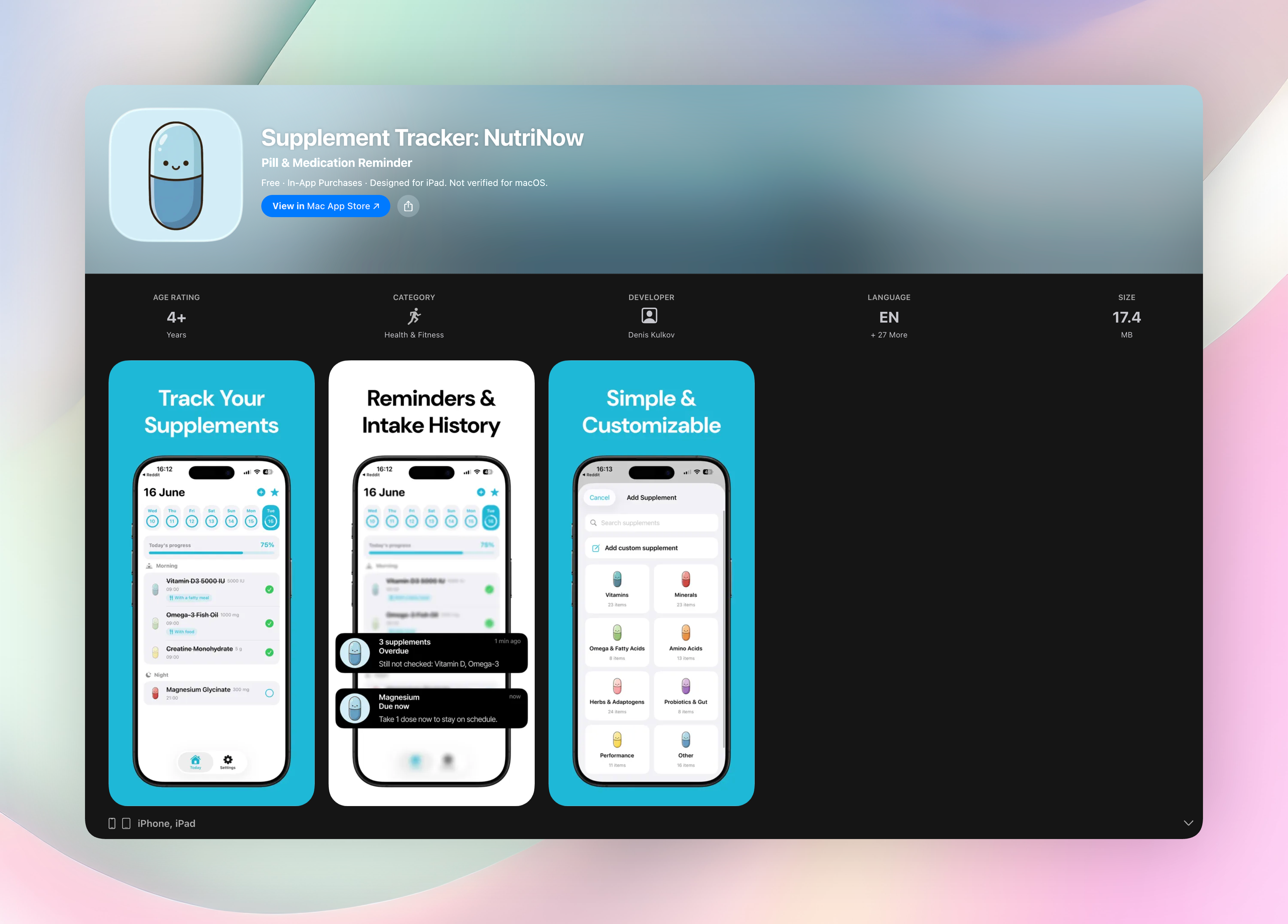
This app skips feature bloat and focuses on one job: making sure you never miss a capsule. The schedule-first layout shows today’s lineup and lets you check off each supplement with a single tap. A countdown clock tells you exactly when the next dose is due, and the notification system nudges gently, no nagging.
What sets it apart are custom smart reminders. You set the schedule, and the app adapts without you fiddling with repeat settings. It logs dose, form, and quick notes, then builds a clean intake history you can scan in seconds. No calorie counts, no nutrition analysis, just a straightforward tool that keeps you consistent. Because it earned the top spot in our hands-on tests, this is the only pick we give a direct download link to.
- Custom smart reminders that actually match your routine
- One-tap check-offs with a countdown to next dose
- Intake log shows exactly what you took and when
- Pause tracking or set auto-finish after a number of doses
- Gentle push notifications that don’t feel like an alarm
Get Supplement Tracker
Supplement Tracker on the App Store
2. SuppCo: Supplement Scanner
Best for: verifying what’s really in your supplements before you buy.
SuppCo’s proprietary database covers over 160,000 supplements, so you can cross-check labels against independent quality scores. Search a product or brand and you’ll see a trustworthiness rating that flags transparency and third-party testing. No other app on this list builds a brand-scoring system into the core experience. It’s a quick way to weed out under-dosed or questionable formulas before they hit your shelf.
3. Vitamin Tracker App
Best for: privacy-focused Android users who want everything stored locally.
This one runs completely offline: no account sign-up, no internet permission, no data leaving your phone. The visual organization presents today’s plan in a colorful, easy-to-scan grid, so you see what’s due immediately. Local-only storage is the real standout here, a rare find among health apps that usually push cloud sync. If you prefer your supplement diary to stay on-device and out of anyone’s reach, it’s a solid pick.
4. SuppTrack
Best for: people who want to track total intake of each ingredient across multiple supplements.
SuppTrack’s barcode scanner pulls up full breakdowns of vitamins, minerals, and micronutrients from its database. That makes it easy to spot if you’re doubling up on magnesium because two different pills both contain it. The ingredient-total dashboard sums everything across your stack, so you know exactly how much of each nutrient you’re getting daily. If you’re managing targeted intake levels, that feature is the standout.
5. Nutrilio
Best for: connecting supplement habits to overall food and health patterns.
Nutrilio treats supplements as one piece of a bigger picture. You log meals and intake together, then review weekly reports that map nutrient consumption trends over time. This gives you a clearer view of where your diet alone falls short and where pills fill the gaps. The weekly nutrient statistics stand out, turning a simple log into a pattern-spotting tool without overwhelming you with raw numbers.
6. SuppWise
Best for: someone who wants an AI coach to personalize their supplement plan.
SuppWise mixes smart reminders with a visual daily check-off system, then layers on an AI-powered nutrition coach. You can ask it about effectiveness, timing, or potential interactions between supplements you’re stacking. For beginners who don’t know which combinations make sense, the AI guidance is the standout. It’s like having a patient explainer built right into the tracker.
7. Cronometer
Best for: nutrition nerds who want micronutrient-level precision.
Cronometer maps everything you consume, food and supplements alike, against daily recommended values with scientific accuracy. It doesn’t stop at vitamin C and zinc; you’ll see numbers for lesser-tracked micronutrients like choline, biotin, or manganese. The micronutrient depth is the standout on this list. If you obsess over hitting exact targets and want the full nutritional footprint of your stack, this is it.
8. Supplements AI – Stack Tracker
Best for: a clean, no-fuss stack tracker without extra features.
This app focuses entirely on logging daily intake and managing supplement schedules, and that’s it. No meal diary, no nutrient analysis, no social stuff, just a straightforward interface for ticking off your morning and evening lineup. The clutter-free design is the standout for minimalists who find most health apps overbuilt. It respects that sometimes all you want is a simple “did I take it” button.
9. MyNetDiary
Best for: calorie counters who also want strong vitamin and mineral tracking.
MyNetDiary puts diet tracking first, but it includes robust supplement logging that merges pill nutrients with your food diary. The app then analyzes your total nutrient targets so you can see how supplements fill the gaps left by meals. The combined diet-and-supplement nutrient analysis is the standout, especially practical for anyone already tracking macros and calories who doesn’t want a separate app just for vitamins.
How we picked these apps
What we looked for
We compared ease of use, reminder reliability, and platform availability across dozens of candidates. Each app had to deliver on its main promise without burying you in unnecessary clutter. We also prioritized developers with clear privacy practices and regular updates. Hype-driven claims got ignored, we only kept tools that genuinely help someone stay consistent with a daily supplement routine.
How we tested
We logged real supplements, set multiple daily reminders, and checked for bugs on both iOS and Android where applicable. Notifications had to fire reliably, and interfaces had to make sense at a glance. Only Supplement Tracker was selected as our top pick based on these tests. No developer paid for inclusion, the #1 spot earned its place through hands-on use.
Frequently asked questions
What is VitaTrack, and why are people looking for alternatives?
VitaTrack appears to be a discontinued or unavailable supplement tracker, so people search for “vitatrack alternatives” to find a working, supported replacement. All nine picks here are actively maintained and tested.
Are these supplement tracker apps free?
Most offer free basic tracking, with premium tiers unlocking extra features. Supplement Tracker’s free version covers full daily scheduling, while others gate advanced reporting or AI features. Check each app’s store page for current pricing before you download.
Which app should I pick if I’m on Android?
Vitamin Tracker App gives you offline privacy, Nutrilio connects supplements to food patterns, Cronometer delivers micronutrient depth, and MyNetDiary blends calorie and vitamin tracking. Supplement Tracker is iOS-only, so Android users should look at picks 3, 5, 7, or 9.
Can any of these apps replace professional medical advice?
No. These are tracking tools, not diagnostic or treatment apps. Always talk to a doctor about supplement interactions or health concerns. Apps help with consistency, never with medical decisions.
The verdict
Supplement Tracker is the best vitatrack alternative for most people because it strips the task down to a simple, reliable daily reminder system. No feature overload, no steep learning curve, just a clean tool that keeps you consistent without the noise. It earned the top spot through direct hands-on testing and real-world usability. While other picks on this list serve very specific needs, this one solves the core problem fastest. Get Supplement Tracker
Free Supplement tools
- Vitamin IU to Mcg ConverterConvert a vitamin label quantity between IU and micrograms. Select the exact vitamin form because IU is a measure of biological activity and its mass conversion is not universal.
- Supplement PlannerTurn the supplement choices you have already made into a simple browser-based timetable. The planner organizes entries; it does not recommend doses or check interactions.